
Stop Trying to Motivate People and Become a Better Leader
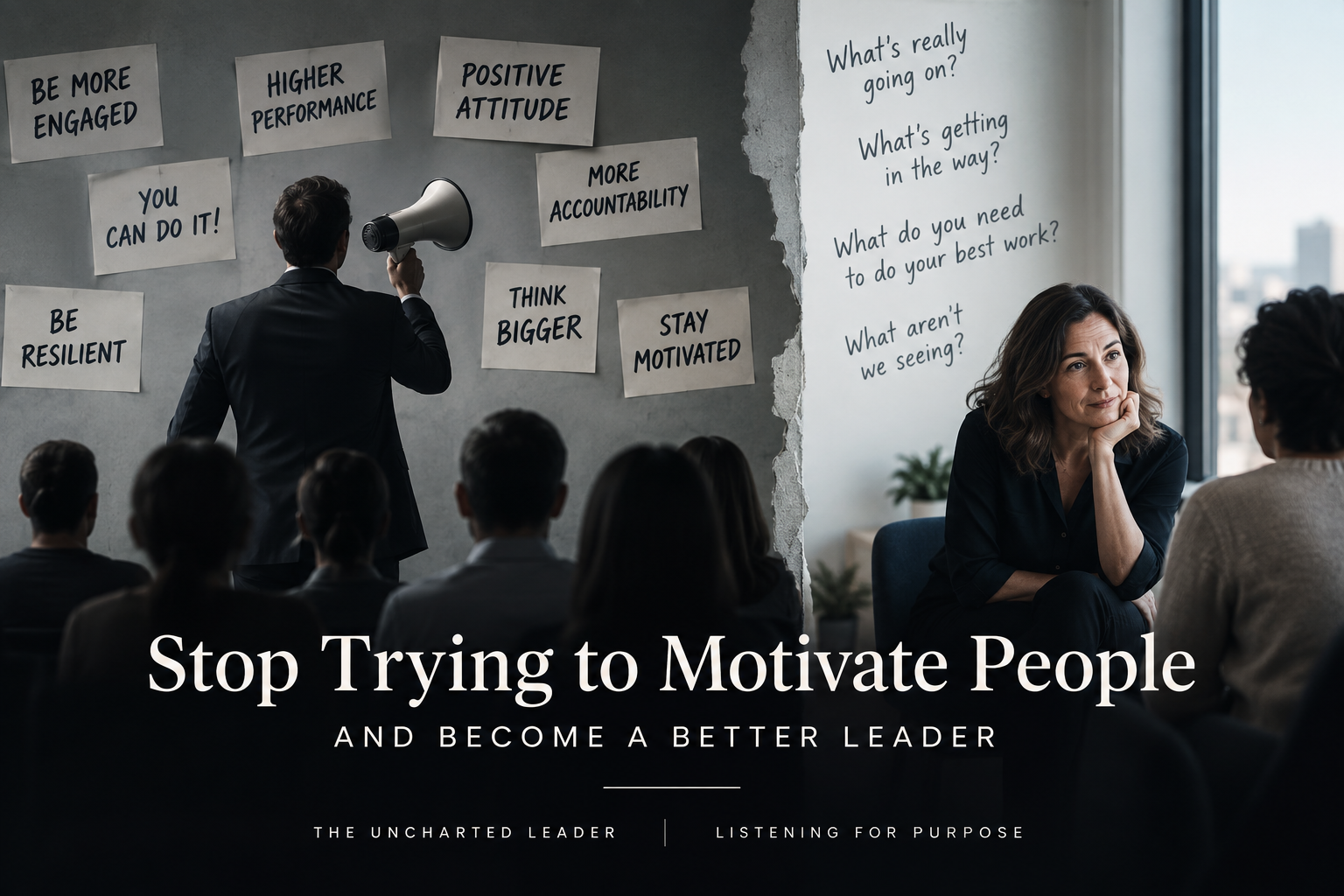
“Leadership isn’t about knowing what to do when you don’t have the answers. It’s about how you lead when you don’t.”
THE SHIFT | 60 second CONTEXT
As leaders, we spend a lot of time trying to fix what we see - Low energy. Poor performance. Silence. Resistance. Disengagement - as if there’s something wrong, in what we see. But behaviour is only the surface.
Sometimes the most powerful thing a leader can do isn't inspire, motivate or have the answer. It's to stop assuming they understand the problem. Because the more certain we become about what's wrong, the less likely we are to discover what might actually be going on.
The shift: “How do I motivate my people?” → “What might I not understand about what’s getting in their way?”
What if disengagement isn't a motivation problem at all?
For decades, leaders have been asking the same question: How do we motivate people?
I know because I was one of them. More than 20 years ago, sitting on the leadership team at News Corp, we’d do what leadership teams everywhere did (and still do). We’d go offsite, get away from the day-to-day, sit together in a room and talk about strategy, culture, performance and engagement.
Inevitably, we’d talk about people, “How do we get them more engaged? How do we lift performance? How do we motivate them? How do we get them to take greater accountability?”
At the time, it seemed entirely reasonable.
Looking back, something strikes me as obvious, simple and extraordinary.
The people we were trying to understand weren’t even in the room.
There we were, a group of leaders, diagnosing what thousands of other people needed to feel more motivated - based largely on what we thought was going on for them. How arrogant is that? Not intentionally arrogant. We cared deeply about our people and wanted them to succeed.
Embedded in the question “How do we motivate them?” was an assumption we didn’t challenge: Motivation was the problem.
What if we’RE misdiagnosING the problem?
People aren’t performing? Motivate them. Engagement is down? Inspire them. Energy is low? Rally the team. Someone looks unhappy? Cheer them up. Someone is quiet? Encourage them to speak up.
We observe something on the surface and respond to what we think it means. But what we see on the surface doesn’t always tell us what someone is experiencing underneath. People aren’t always disengaged because they lack motivation.
What looks like disengagement may actually be someone dealing with unclear priorities, endless meetings, slow decisions, unnecessary work, conflicting expectations or workloads that keep expanding.
The research gives us good reason to question the diagnosis.
Gallup's State of the Global Workplace 2026 found global manager engagement has fallen nine percentage points since 2022, reaching just 22% in 2025. Yet in best-practice organisations, 79% of managers are engaged — nearly four times the global average.
Microsoft's 2025 Work Trend Index found almost half of employees (48%) said their work felt chaotic and fragmented. Its Microsoft 365 telemetry also found that among the highest-volume users, employees were interrupted by a meeting, email or chat on average every two minutes during core work hours.
Asana's Anatomy of Work Global Index 2023 found knowledge workers spend 58% of their day on “work about work” — coordinating work rather than doing the skilled, strategic work they were employed to do. They estimated improved processes could save them 4.9 hours every week.
““We cannot solve our problems with the same thinking we used when we created them.””
No amount of cheerleading, fun or motivational off-sites will fix poor work design.
While it may not have been evident, what we’re seeing is a focus on trying to change the person and their behaviour, instead of challenging ourselves on changing the conditions their surviving in. Think about it - what are some of the things we’re asking of people?
They need to focus, while filling their calendars with meetings.
They need to accountability, while requiring multiple layers of approval before they can make a decision.
They need to prioritise, while giving them fifteen priorities.
They need to be more creative and innovate, while leaving them no time to think.
They need to be more resilient, while continuing to add to their workload.
And when they struggle, we wonder how to motivate them.
What looks like a motivation problem is sometimes an environmental problem.
It’s not just employees who are struggling, leaders are also struggling. Everyone’s struggling, looking outside for the answer, without exploring their own internal locos of control, and there lies the paradox.
Leadership isn't about having the answer, and yet it is.
We've inherited an idea of leadership that places enormous value on knowing. Leaders are expected to know what's wrong, they need to know what people need, they need to know what to do next and they need to know how to fix it.
I spent years leading this way, sitting in rooms talking about how to motivate people who weren't even there, without considering that we didn't actually know what they were experiencing.
There’s the trap: The more certain we are that we know the problem, the less curious we become about what the problem might actually be.
After 25 years of leading people, teams and transformation, I learnt a powerful lesson: Leadership isn't about knowing what to do when you don't have the answers. It's about how you lead when you don't.
It requires a shift:
Less certainty. More curiosity.
Less fixing. More understanding.
Less assuming. More listening.
Listen before you lead
Listening for Purpose isn’t simply listening to what someone says. It's becoming curious about what might sit beneath the behaviour we're observing. What's getting in the way? What isn't being said? What matters here? What assumption am I making? What does this person need to do their best work?
Most importantly: What might I, or the system we’re operating in, need to change?
Try it out. Next time someone appears disengaged, unmotivated, overly quiet or resistant, resist the temptation to immediately fix what you see. Get curious about what you don't know.
Ask yourself: What might I discover if, instead of trying to motivate people, I listened for what's getting in the way of their best work?